One of the significant assumptions which underlie this project is that the Western world is entering a Post-Christian era. This differs from the “Pre-Christian” era, in which the Christian narrative is not well-known, or the “Christendom” era, in which the Christian narrative is presumed as the default of society. Rather, Post-Christianity is characterized by the Christian narrative being both familiar but also largely ignored. Edwin van Driel writes of our Post-Christian era, “It is not only that the culture no longer supports the church, but that the Christian faith is simply losing its relevance and plausibility for a growing group of people in our society.”1 While in Christendom, belief in the Christian God was assumed; in Post-Christianity, unbelief is, if not assumed, often more palatable than belief.
While I grant that our culture is not yet entirely Post-Christian, especially given the outsized influence of Christianity in American politics and government, increasing secularization among residents of the United States is hard to ignore.2 There is significant evidence from polling for this increased secularization. Ryan Burge, a pastor and social scientist, has performed extensive research on the people he calls the “nones” or “nothing in particulars”—a fast-growing group of people who report no religious affiliation. In his work, The Nones, Burge uses data from the General Social Survey through 2021 to present a snapshot of the religious landscape of the United States over time. Between 1978 and 2018, Burge notes a significant change: the number of people who report a mainline protestant affiliation and who report no religious affiliation have effectively swapped their share of American adherents.3 While making up 31 percent of the American population in 1976, by 2016 mainline protestants had shrunk to only 10 percent of the population.4 Similarly, those with no affiliation rose rapidly, from 6 percent in 19915 to 28 percent in 2021.6 This survey data shows a distinct change in those fifty years, when the question “What church do you attend?” might have been as frequent as “Where do you work?” Instead, a quarter of Americans shared that religion has no importance in their lives.7
One might assume from this data that the rise of those with no religious affiliation corresponds with a similar rise in those who identify as atheists, but Burge’s data does not support that conclusion. Burge finds the most representative group is not those who self-select atheist or even agnostic for their religious beliefs, but those who identify as “nothing in particular.” He writes, “Nothing in particulars are the definition of the nonreligious and they also happen to be one of the largest religious groups in the United States… In the general American population, nearly one in four Americans is a nothing in particular.”8 As Burge describes earlier, “These are people that just don’t feel strongly about religion one way or another.”9 Burge’s nothing in particulars as a category of people are defined in light of their lack of attention to religious particularity and are not interested in those things which interest religions and religious people. When it comes to belief, they are simply apathetic.
Jonathan Rauch, writing about this state of general disinterest in religion along with his own apathy about the religion in which he was raised, popularized the term “apatheism” (a portmanteau of “apathy” and “theist”) in a 2003 article for The Atlantic. Rauch describes his own apatheism as “a disinclination to care all that much about one’s own religion, and an even stronger disinclination to care about other people’s.”10 Rauch views apatheism through the lens of tolerance; for Rauch, it is the logical next step for living in a pluralistic world. While tolerance and an embrace of pluralism are features of apatheism, it is also growing into a distinct philosophical position on its own, though one that is only recently being explored.
Continuing to explore this concept of apatheism, Trevor Hedberg and Jordan Huzarevich write with regard to what they call “existence questions,” which they abbreviate as “EQs.” Existence questions are those which explore if or not God exists, how we know God does or does not exist, and so forth. Hedberg and Huzarevich describe apatheism as a philosophical position with two key features, both of which express disinterest in the answers to existence questions:
First, as the name suggests, apatheism refers to an attitude of apathy toward God and supernatural beliefs. An apatheist is not particularly concerned about whether her answers to EQs are correct. Second, apatheism is distinct from theism, atheism, and agnosticism. A theist believes that God exists; an atheist believes that God does not exist; an agnostic believes that we cannot know whether God exists; an apatheist believes that we should not care whether God exists. Apatheism is orthogonal to these other positions: whether one is a theist, atheist, or agnostic does not logically entail that one must be an apatheist or an anti-apatheist.11
Apatheism is not a separate category of belief from atheism, agnosticism, or theism, but is best understood as an additional descriptor in understanding a person’s belief. An apatheist might continue to believe in a god or gods, or might not, but what makes them apatheistic is their holding those beliefs or lack of beliefs weakly enough to not identify themselves with any particular position. This is reminiscent of Burge’s description of the nothing in particulars, and I would suspect a good deal of overlap between them and apatheists, though this connection invites further exploration. Apatheism is another way to describe the growing number of people in a Post-Christian era who do not neatly fit into Christendom era categories.
Hedberg and Huzarevich focus on a particular subcategory of apatheists they call “practical apatheists,” the same category of people this paper interacts with. These are people who may entertain a conversation about the existence of god or think deeply about deity at times, but it does not affect the way they live their life. Hedberg and Huzarevich describe the practical form of apatheism as distinct from an intellectual form: “Practical apatheism is an attitude of apathy or indifference toward EQs grounded in the belief that their answers lack practical significance. Intellectual apatheism is an attitude of apathy or indifference toward EQs grounded in the belief that there are no compelling intellectual reasons to investigate EQs.”12 Hedberg and Huzarevich are not focused on an apatheism which considers existence questions as a philosophical exercise, but rather the way a person’s apatheism is lived out. This is an important distinction, especially with regard to a Post-Christian era. A person could find philosophical discussions of the existence of deity both important and compelling, even as they see the answers to those questions as having no practical expression. Alternatively, a person could quite easily believe in the existence of deity, or even be confident that a god or gods exist, but if that belief has little practical effect on their lives they would find themselves in a category of apatheistic theism.
Adam Kunz continues Hedberg and Huzarevich’s description of apatheism in very practical terms, offering a more functional definition: “Apatheism is the philosophical attitude of indifference and reciprocity, both public and private, to (1) the question of the existence of a deity, (2) the interaction of the deity with the universe, and/or (3) the value of loyalty to that deity.”13 Kunz expands on Hedberg and Huzarevich’s description of apatheism as distinct from belief. In Kunz’s definition, one’s belief is the answer to the question, “Do you believe in god?” and one’s attitude is answering the question, “How much energy do you dedicate to this belief?”14 To visualize this idea, Kunz created a chart with two axes, belief and attitude. He uses the belief aspect, from atheism to theism with agnosticism in the middle, as the horizontal axis and the attitude aspect, from zealotry, defined as “an attitude of exclusionary intensity with regard to religious beliefs,”15 to apatheism, on the vertical axis. I have included Kunz’s visualization as Figure 1.
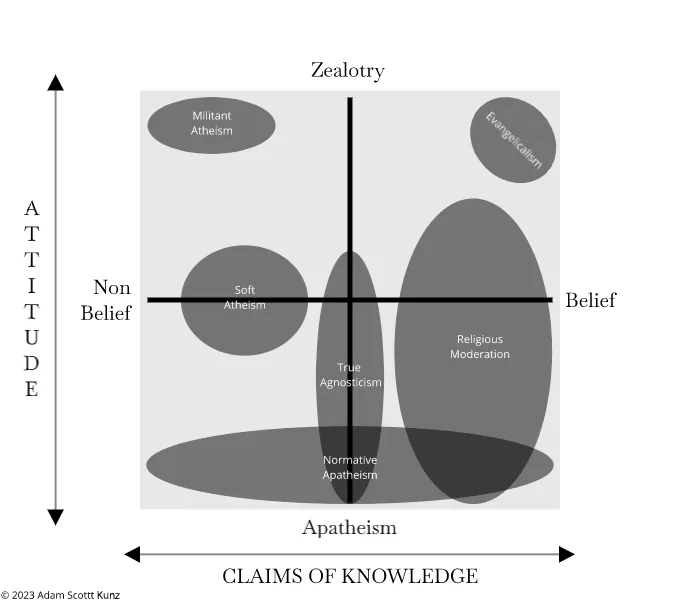
I find the concept of apatheism to be a useful one in understanding a Post-Christian era. While all generalizations have their downsides, a model which covers both beliefs and attitudes about belief is helpful for Christians to better respond to the realities of a time in which one in four Americans have sufficient apathy about religious belief that they self-report no particular religious affiliation. While so far I have described the situation facing the church in a Post-Christian era, the question remains: what does this mean for how people experience a transcendent God? In the next section, I explore this question through interactions with the works of Charles Taylor and William Cavanaugh, to seek out how people living in a Post-Christian era encounter things which are beyond themselves, including deity, and how that differs from prior eras.
Notes
- Edwin Chr. van Driel, “Rethinking Church in a Post-Christian Age,” in What Is Jesus Doing?: God’s Activity in the Life and Work of the Church, ed. Edwin Chr. van Driel (Downers Grove, IL: IVP Academic, 2020), 47–48. ↩︎
- David A. Hollinger, Christianity’s American Fate: How Religion Became More Conservative and Society More Secular (Princeton: Princeton University Press, 2024), xi. ↩︎
- Ryan P. Burge, The Nones: Where They Came from, Who They Are, and Where They Are Going, Second Edition (Minneapolis: Fortress Press, 2023), 13, fig. 1.1. ↩︎
- Burge, 18. ↩︎
- Burge, 26, fig. 1.8. ↩︎
- Burge, 155. ↩︎
- Burge, 168, fig. 5.9. ↩︎
- Burge, 114–15. ↩︎
- Burge, 114. ↩︎
- Jonathan Rauch, “Let It Be,” The Atlantic, May 2003, https://www.theatlantic.com/magazine/archive/2003/05/let-it-be/302726/. ↩︎
- Trevor Hedberg and Jordan Huzarevich, “Appraising Objections to Practical Apatheism,” Philosophia 45 (March 2017): 259, https://doi.org/10.1007/s11406-016-9759-y. ↩︎
- Hedberg and Huzarevich, 260. ↩︎
- Adam Kunz, To Hell with Heaven: An Introduction to Apatheism (United Kingdom: Hypatia Press, 2024), 34. ↩︎
- Kunz, 53–54. ↩︎
- Kunz, 60. ↩︎