The decline of religious participation in the United States of America is a representation of a greater shift in the way Western culture encounters transcendence. There is a significant increase in those whom Ryan Burge calls “nothing in particulars” and a coincident rise in apathetic attitudes towards religious belief. This section explores the background for rising apatheism in Western culture in general and American culture in particular. I suggest that, in a Post-Christian era, encounters with transcendence have developed an optionality which was implausible in prior eras: the Christian God is but one choice among many transcendent experiences. In this midst of this discussion, I will also describe a framework for understanding different encounters with transcendence, one that is helpful in understanding the ways people in this secular age connect with something larger than themselves.
First, I should offer a working definition for how I am using the terms “transcendence” or “transcendent.” In its most straightforward way, something transcendent is outside of human knowledge or experience. An encounter with transcendence exists beyond what Charles Taylor describes as the “immanent frame:” the rational and natural social space which defines the current world and denies the supernatural and transcendent.1 In this section, I will explore the Post-Christian experience of transcendence that does not necessarily connect to the Christian God, yet hold distinct meaning for those who experience these transcendences.
Charles Taylor, in his comprehensive work, A Secular Age, explores what it means to believe in something larger than oneself in a world that imagines little more than what is in front of one’s face. He summarizes his own work as answering the question: “Why was it virtually impossible not to believe in God in, say, 1500 in our Western society, while in 2000 many of us find this not only easy, but even inescapable?”2 In providing his answer, Taylor develops the term “social imaginary,” summarized by James K. A. Smith as “a way of constructing meaning and significance without any reference to the divine or transcendence.”3 The social imaginary is what Taylor is exploring, clarifying those assumptions about the world which most of us in 21st Century Western culture hold but rarely think about.
Taylor begins by describing the makeup of the “1500s” world as an “enchanted” one. People understood that the Christian God was active and involved in the events of the world. In this “medieval imaginary”4, people assumed God was present in the structures and systems which constitute human society and there were other supernatural forces like spirits and demons which were also present and active in the world. Taylor, however, is less concerned with the actual beliefs of the people of that (and this) age, instead focusing on the believability of an alternative. How possible is it to not believe in the prevailing imaginary? He tells a story of “disenchantment,” not as a growth from naivety to wisdom, but as a shift from the medieval imaginary to a modern social imaginary which prefers what is immanent to what is transcendent—a world in which supernatural experiences are discounted in favor of what appears natural.
A significant part of Taylor’s framework is the shifting meaning of the word “secular” and the differing ways Western culture understands what it means to be secular. The first secularity Taylor describes, notated as “secular1”, is that of the medieval period, in which secular meant “in the world” as opposed to “apart from the world.” James Smith summarizes Taylor’s thoughts in this way: “The priest, for instance, pursues a ‘sacred’ vocation, while the butcher, baker, and candlestick maker are engaged in ‘secular’ pursuits.”5 God is not absent from the butcher’s profession; a secular1 understanding is the butcher’s work is more involved with the world than that of the priest. This may also be seen in the idea of “secular” priests who served in local parishes as a separate category from “religious” priests who were cloistered in monasteries.
What Taylor calls “secular2” is our more familiar understanding, which refers to something both outside of and separate from the Christian church in particular or any religion in general. In a secular2 understanding, God is now meant to be absent from “public” spaces like government or the butcher shop; God belongs in religious environments alone. Smith alludes to people with no religious affiliation as seeing themselves as secular; he also uses the examples of public, secular schools that do not encourage belief in a particular religion like parochial schools do.6 A secular2 definition informs the separation of church and state in the United States: the government, as a secular institution, should not exert influence over churches which exist in the religious sphere.
The third secularity, “secular3”, is the one Taylor means in his title, A Secular Age. Quoting Smith’s summary, “A society is secular3 insofar as religious belief or belief in God is understood to be one option among others, and thus contestable (and contested). At issue here is a shift in the ‘conditions of belief.’”7 In secular3, the social imaginary is situated fully within the immanent frame rather than encounters with transcendence. Though Taylor does not use the term “Post-Christian”, this is how Taylor might identify Post-Christianity: an era in which belief in the Christian God is one option among many, one choice on a menu of innumerable options of belief. The existence of the Christian God is no more certain than the claims of any other religion or the claim the there is no transcendent god at all.
The centrality of the immanent frame in secular3 leads to conflicts, though not only a two-sided conflict between those who encounter transcendence and those who do not. Instead, it is a three-way conflict between those who are open to transcendence (Beyonders) and two different expressions within the immanent frame, Exclusive Humanism and Antihumanism. These expressions may be visualized as corners of a triangle, on which movement is possible along the edges of the triangle, as shown in Figure 2.
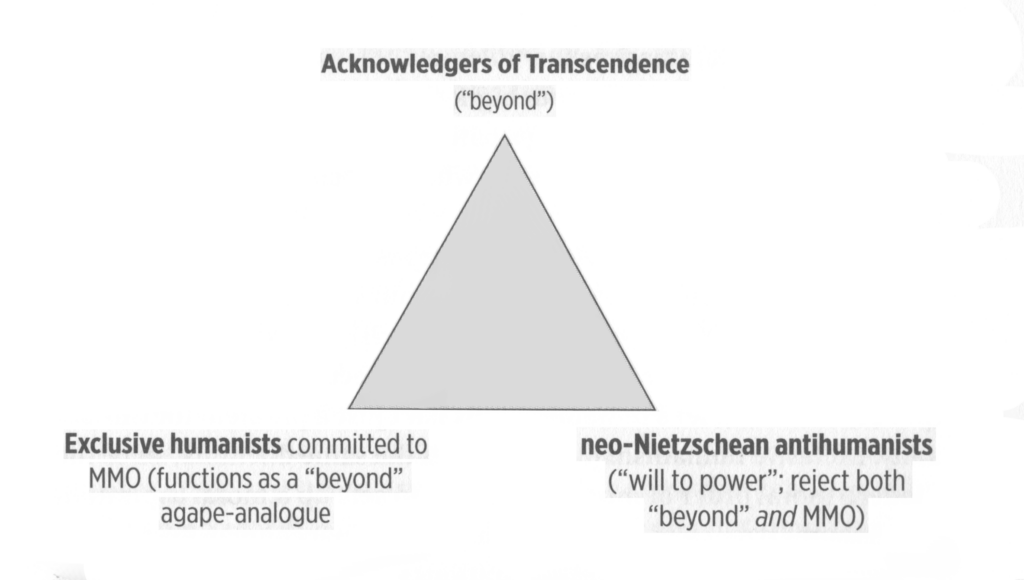
Andrew Root summarizes Taylor’s perspective on these various corners in idealized but helpful ways, while also connecting them to understandings of transcendence present in the work of William Desmond. Root uses the term “mysticisms” to refer to the three corners of this triangle. Root says of the Exclusive Humanists, in the bottom-left corner of the triangle, they are deeply committed to human flourishing and that all human flourishing is worked out by humans. They reject anything that offers a life beyond death (namely the Beyonders, whom Root describes last of these three), seeing anything outside of the immanent as an attempt to draw attention away from human flourishing by offering alternatives the Exclusive Humanists consider non-essential.8 They are committed to what Taylor calls the “modern moral order,” described by Smith as an understanding of morality which focuses on mutual benefit rather than any commitment to a transcendence.9 To ensure the flourishing of all, society must be tolerant and accepting of whatever each person needs to flourish. Exclusive Humanism is motivated by a mysticism of inner genius, which Root describes as “a mysticism that believes that the fullness of flourishing is internal acceptance of your desires as your identity.”10 A person finds their identity and purpose inside of themselves, and on finding it, that identity and purpose should be respected and encouraged by everyone else.
The second corner, in the bottom-right, are those whom Root calls the “Counter-Enlightenment” and Taylor calls “Antihumanists.” They reject the Exclusive Humanist support of the modern moral order, and a significant aspect of the Antihumanist identity is connected to this rejection. Root describes Antihumanists as agreeing with the Exclusive Humanists that there is nothing beyond death, but they rejects Exclusive Humanism’s commitment to the modern moral order and the tolerance and pluralism inherent to it. For the Antihumanist, the modern moral order is not beneficial; it is seen as a tool for control to keep the strong from being strong and prevents heroes from being heroic.11 This leads to the mysticism which motivates the Antihumanists, external heroic action. Root explains, “To embrace your power to reject what the lemmings are doing and lay hold of your own destiny leads to transcendent euphoria.”12 Decisive individual action which rejects the perceived “norms” of modern moral order is the ideal of Antihumanism.
The final corner of this triangle, at the top, is the Beyonders, who claim that there is something more to life than only human flourishing (frustrating the Exclusive Humanists) and that there is something beyond death (frustrating the Antihumanists and the Exclusive Humanists). According to Root, the mystical motivation of the Beyonders is an encounter with something outside of the self which breaks into and upon the self, the transcendent God. This puts Beyonders in conflict with both Exclusive Humanists and the Antihumanists. For the Beyonders,
The mystical path is to surrender and stop all performances by confessing the need for the inbreaking encounter with true otherness… This Beyonder mystical path is still walked but not with the traffic of the other two, because it is the path that cannot be walked without an encounter with the living God of becoming. This form of mysticism cannot be done without God, for it must surrender to the fact that the performing self cannot save itself.13
In Root’s explanation of this triangular conflict of worldviews, the Beyonders interact with transcendence through a mysticism of inbreaking, and with it an openness to surrender themselves to something outside of human control. Exclusive Humanists are only interested in immanent human flourishing through the modern moral order, and thus reject any understanding of transcendence beyond that flourishing. The Antihumanist rejects that particular moral order, while remaining solely focused on the immanent frame, also rejecting the transcendence of the Beyonders.
Yet even the Beyonders are affected by the social imaginary of a secular3 age. Taylor highlights the shift of religious experience away from poetic expressions of the transcendent to a prosaic application to the immanent frame.14 In the modern social imaginary, “all order, all meaning comes from us… A race of humans has arisen which has managed to experience its world entirely as immanent.”15 Referring back to the triangle, the Beyonders find themselves pulled, as if by the gravity of the modern social imaginary, away from any inbreaking from beyond the immanent frame towards either of the other corners of the triangle. Root uses the example of American Protestantism in the last century to emphasize this pull:
Some Protestants became modernists in the 1920s, sliding down and linking up with the E.Hums [Exclusive Humanists]. Their core tenants were as bound in exclusive humanism as they were bound in the sacred tradition. In the 2020s, some Protestants have slid down the other side of the triangle, linking arms with right-wing CEs [Antihumanists/Counter-Enlightenment]. The core of their faith is as much a heroic nationalism as anything else.16
In the modern social imaginary, the immanent frame’s centrality leaves little room for transcendence. Taylor is firm in this assertion. Andrew Root’s description of the motivations of the Exclusive Humanists and Antihumanists follows Taylor, carefully avoiding transcendence by using the term “mysticism” in its place, except when he refers to Desmond’s work. In doing so Root stays in Taylor’s secular3 framework that the Beyonders are the only ones who choose to experience transcendence. This avoidance raises its own question: is the world completely disenchanted or is there something that Taylor (along with Smith and Root following him) misses in his analysis of the Post-Christian era? I believe there is, as is discussed in the work of William Cavanaugh.
Cavanaugh, in his book The Uses of Idolatry, argues the point that Root dances around: the key feature of the Post-Christian17 era is not that people no longer connect with any transcendence; instead there has been a change in what transcendences people connect with. The Post-Christian era is not defined by disenchantment and the implausibility of transcendence, as Taylor argues, but by “misenchantment.” Cavanaugh agrees with Taylor that Post-Christianity’s key feature is optionality, that a transcendent encounter with the Christian God is one choice among many others. Where Taylor sees a disappearance of experiences of transcendence, Cavanaugh sees a shift in those experiences. He writes, “The holy in this case has not simply disappeared from things but has migrated to other kinds of things and taken on different modalities.”18 Cavanaugh goes on to name the primary aspect of his critique of Taylor:
What has declined in the modern West is not belief in transcendence; what has declined is belief in God. But if Taylor is right that humans have an inherent desire for God, then those longings will appear in all kinds of places, including rock concerts and consumer goods, even if they are misrecognized as such.19
For Cavanaugh, Post-Christianity is characterized by people seeking transcendence away from religion, specifically the Christian religion, which is the point Root devotes significant effort to avoid making in his own analysis of Taylor.
To explore this misenchantment, Cavanaugh uses the lens of idolatry, “that human beings are spontaneously worshiping creatures whose devotion alights on all sorts of created things that are not God”20 and that human worship of these created things is at its core an exercise in narcissism. This worship of self rather than worship of God connects back to Taylor’s triangle, and even gives it renewed usability. The Exclusive Humanists and Antihumanists continue their focus on the self. In their misenchantment, their object of worship is not God, but is either the modern moral order which promotes their own flourishing or the exercise of power. Despite this, through their inner genius in the case of the Exclusive Humanists or heroic action for the Antihumanists, they encounter a kind of transcendence. Even the Beyonders are not exempted; in the experience of God through the modern social imaginary, they create an image of god as a mirror to themselves and the transcendences they connect with, little different from the physical idols of the past.
Cavanaugh offers two overarching examples of the kinds of misenchantment present in Post-Christianity: nationalism and consumerism. In each, he shows the migration of encounters with transcendence from God to something else. In nationalism, as the church’s own power declined, the state became the sacred thing to be worshiped. In consumerism, brand loyalty replaced religious identity and trips to Disneyland replaced pilgrimages. Things that once were holy became profane; things that once were secular became sacred.21
This is what characterizes Post-Christianity: rather than vanishing from the modern social imaginary, encounters with transcendence occur more frequently outside of their former realm of religion. For Cavanaugh, this misenchantment is idolatrous, as humans shift from worshiping the creator to worshiping something created. In Cavanaugh’s response to misenchantment, however, I see a possible point of connection with apatheists. For Cavanaugh, the answer to idolatrous misenchantment is “simultaneously to see God in things and not to make a god of things,”22 which he proposes is based in Jesus’ incarnation, as deity came to be with creation.23 Though Cavanaugh builds to the sacraments as the means to encounter God, especially the seven-fold sacraments of Roman Catholicism, in making his argument he detours through a discussion of icons and their distinction from idols. He explains that icons are a visible representation of something invisible, not unlike the Incarnation itself. He writes, “The icon thus inverts the mirroring effect of the idol. Whereas the idol is a mirror that reflects back to us our own desires, in the icon we encounter its desires, or rather the desires of God’s gaze that come from beyond it.”24 What makes something an icon or an idol is, fundamentally, its viewer and their willingness to surrender to inbreaking transcendence. Cavanaugh continues, “An image is iconic if the person encounters God through it, if it reveals its relation to God, and the person receives that gift and enters into communion with God.”25 Whether a particular transcendence is idolatrous or iconic, one might say, is determined by the attitude of the person encountering it.
This is where I find a connection with apatheism. Apatheists still encounter transcendence, though usually not an inbreaking, divine kind. Milenko Budimir, writing on apatheism, says of these encounters,
I believe it points to a fundamental shift away from passion for one kind of thing, i.e., passion for religion and the beliefs that stand behind it and the world it represents, and toward passion for things such as products and product brands, the staples of market economies which are the results of free market capitalism and liberal democratic institutions. Or toward sporting teams and countries which are inevitably bound up with nationalism, ethnocentrism, and with a certain mild form of provincialism.26
Budimir sees a very similar shift as Cavanaugh, with passion (or zealotry) about religion shifting to consumerism, nationalism, athletics, or any of a number of other options. What Budimir does not do is connect this shift in passions to encounters with transcendence. He focuses solely on this shift of passion, though his description is similar to the way I have been using transcendence. Cavanaugh would likely see these connections as idolatrous, and yet in them I see the potential to serve as icons. To further this exploration, I look to another example, one that has significance both to myself and the people I interviewed: the 2004 massively multiplayer online role playing video game, World of Warcraft.
In the book Virtually Sacred, Robert Geraci explores encounters with transcendence in two online video games, World of Warcraft and Second Life, though I will focus on his treatment of World of Warcraft. Geraci argues that through experiences within the games, players connect with something beyond themselves. Taylor’s triangle is useful for identifying some of these connections, recognizing them as a kind of transcendence as understood by Cavanaugh. In one sense, players connect to the Antihumanist transcendence of heroic action: “Every player has the opportunity to become a warrior-saint struggling to defend the community and rise above the limits of mortal life.”27 Through their character, the player takes control by defeating the status quo of the world of the game. In another sense, players’ social interactions allude to an Exclusive Humanist transcendence of inner genius. Each character the player creates has an “identity,” based around variables such as race, class, and role; and each of those characteristics have value to the gameplay. Flourishing in this context is progressing through the game’s content, and each class and role has inherent value in promoting that flourishing, especially as the player grows in realizing their “identity” as their class and role describe. This leads to a complex set of internal ethics, not unlike the modern moral order, which assist in game progression, especially among the more serious guilds.28 Geraci describes a digital world that is a vehicle for encountering the transcendent in ways that were once accessed through the realm of religion.29 There even is an aspect of inbreaking, as the player chooses to surrender themselves to the narrative and rules of the game-world itself; rather than deity, the Beyond they encounter is intentional game design.
Transcendent encounters like those in World of Warcraft might serve as a gateway to an openness to the inbreaking transcendence of God. Whether those connections act as idols or icons, to use Cavanaugh’s distinction, depends on the one who encounters it. Certainly, the “in-game moral order” or the thrill of defeating the latest virtual enemy can be as much of an idol as the modern moral order or strong heroic action, yet one could also see something of God in them. In the modern social imaginary with its disinclination to look beyond the immanent frame, these transcendent encounters foster a broadening of the plausibility of encounters with other transcendences, preparing the way to experience a transcendent God.
This exploration of encounters with transcendence in a Post-Christian era serves to describe the conditions in which the Christian church today exists. Encounters with something larger than oneself are no longer contained within the sphere of religions. In the Western world this means that Christianity no longer has an exclusive claim on transcendent experiences. Instead, we experience the world in a social imaginary through which people are finding meaning, purpose, and transcendence without any connection to God. People are increasingly apathetic about the claims of Christians to God’s existence. This is the environment in which we find ourselves and which this series explores. How might the church respond in a Post-Christian era? To answer that question, I sought those outside of the church, inviting them to share their spiritual stories and experiences with Christians. The results of that exploration inform the remainder of these sections, as I ask how the church might best bear witness to the reign of God when belief in God is one option among many.
Notes
- Charles Taylor, A Secular Age (Cambridge, MA: Harvard University Press, 2007), 542. ↩︎
- Taylor, 25. ↩︎
- James K. A. Smith, How (Not) to Be Secular: Reading Charles Taylor (Grand Rapids: William B. Eerdmans Publishing Company, 2014), 26. ↩︎
- Smith, 27. ↩︎
- Smith, 20–21. ↩︎
- Smith, 21. ↩︎
- Smith, 21–22. ↩︎
- Andrew Root, The Church in an Age of Secular Mysticisms: Why Spiritualities Without God Fail to Transform Us (Grand Rapids: Baker Academic, 2023), 86–87. ↩︎
- Smith, How (Not) to Be Secular, 142. ↩︎
- Root, The Church in an Age of Secular Mysticisms, 108. ↩︎
- Root, 90. ↩︎
- Root, 107. ↩︎
- Root, 111. ↩︎
- Taylor, A Secular Age, 615. ↩︎
- Taylor, 376. ↩︎
- Root, The Church in an Age of Secular Mysticisms, 95. ↩︎
- Cavanaugh does not use the term “Post-Christian” in his discussion of misenchantment. I am choosing to use Post-Christian for the sake of internal consistency. ↩︎
- William T. Cavanaugh, The Uses of Idolatry (New York: Oxford University Press, 2024), 88. ↩︎
- Cavanaugh, 93–94. ↩︎
- Cavanaugh, 103. ↩︎
- Cavanaugh, 292. ↩︎
- Cavanaugh, 334. ↩︎
- Cavanaugh’s argument here connects with the work of Samuel Wells that forms a portion of my own argument in a later section. ↩︎
- Cavanaugh, The Uses of Idolatry, 360. ↩︎
- Cavanaugh, 364. ↩︎
- Milenko Budimir, “Apatheism: The New Face of Religion?,” Proceedings of the XXII World Congress of Philosophy 45 (2008): 90, https://doi.org/10.5840/wcp22200845254. ↩︎
- Geraci, Virtually Sacred, 17. Emphasis in original. ↩︎
- Geraci, 39–40. ↩︎
- Geraci, 99. ↩︎